

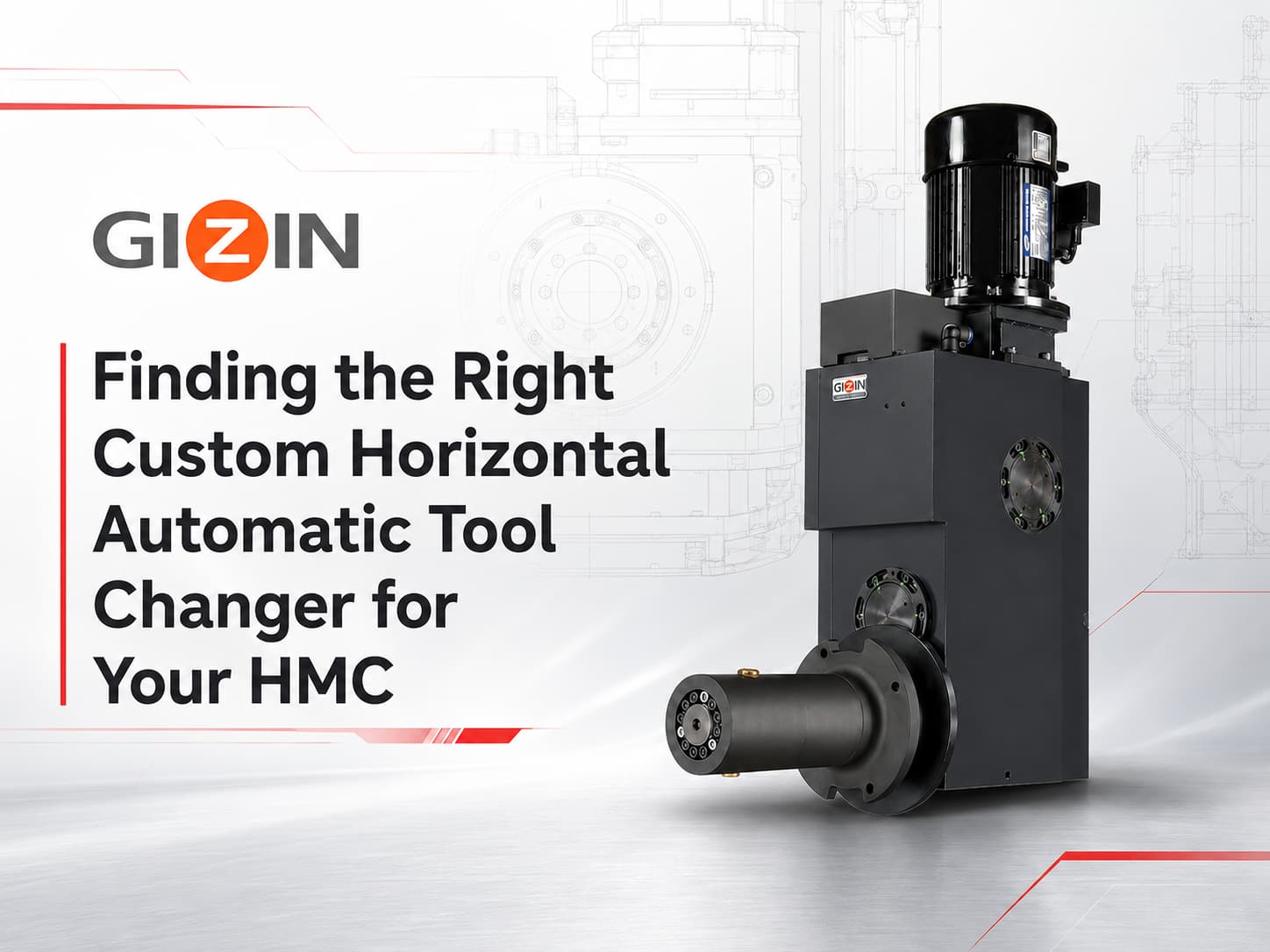
Finding the Right Custom Horizontal Automatic Tool Changer for Your HMC
When developing a new Horizontal Machining Center (HMC), selecting the right spindle, guideways, and control system is only part of the equation. An equally important component is the horizontal automatic tool changer, which directly influences machining efficiency, machine reliability, and the overall user experience.
While many automatic tool changers on the market are offered as standard products, HMC builders often discover that their machine requires something different. Differences in machine layout, tool specifications, installation space, and production goals frequently make customization the better solution.
With more than 20 years of experience in ATC manufacturing, GIZIN helps machine builders develop customized horizontal automatic tool changer solutions that fit each machine's unique requirements. Rather than limiting customers to fixed specifications, we combine proven ATC platforms with flexible engineering to support OEM machine development.
Why Every HMC Requires a Different ATC Solution
No two horizontal machining centers are exactly alike.
Machine builders may use different spindle configurations, magazine locations, machine structures, or machining strategies depending on their target industries. As a result, the automatic tool changer must be designed to work seamlessly within the overall machine architecture.
For example, an HMC designed for heavy-duty cutting may require stronger arm rigidity and higher tool weight capacity, while another machine built for high-speed production may prioritize faster tool change cycles. Some projects have limited installation space, while others require special magazine arrangements or unique spindle interfaces.
Trying to force every machine to use the same standard ATC often leads to unnecessary compromises. Choosing an ATC solution that can be optimized for the machine allows builders to achieve better performance while simplifying the overall design process.
Customization Is More Than Changing Dimensions
Many people assume customization simply means changing the size of an automatic tool changer. In reality, successful customization involves evaluating the entire machine and optimizing the ATC accordingly.
Depending on the application, GIZIN can adjust various aspects of the design to better suit customer requirements.
Tool Interface Compatibility
Different HMC platforms may require BT, CAT, HSK, or other spindle interfaces. The ATC must accurately match the selected tool system to ensure reliable tool exchange.
Tool Weight and Tool Size
Larger cutting tools place greater demands on the arm structure and tool handling mechanism. Optimizing the design helps maintain stable operation while supporting heavier tools.
Tool Change Motion
The movement sequence, cam profile, and arm motion can all be optimized according to the customer's machine layout and production requirements, helping improve both speed and reliability.
Installation Configuration
Machine builders often have different installation spaces and structural limitations. Adjusting mounting dimensions and surrounding mechanical interfaces helps simplify integration during machine assembly.
Structural Design
Depending on the application, the arm structure, internal mechanism, and overall ATC configuration can also be optimized to achieve the ideal balance between rigidity, durability, operating speed, and long-term reliability.
Proven Platforms with Flexible Engineering
One common concern among machine builders is that customization requires designing an entirely new product from the beginning.
In reality, that is rarely the most efficient approach.
Instead of starting every project from scratch, GIZIN develops customized solutions based on proven ATC platforms that have already been validated through years of production and real-world applications.
This approach allows customers to benefit from both proven reliability and engineering flexibility. Rather than redesigning every component, our engineering team focuses on optimizing the parts that truly matter for each application, reducing development risks while shortening lead times.
More Than Standard Products
The automatic tool changers displayed on GIZIN's website represent proven product platforms rather than fixed specifications.
For many OEM projects, customers require modifications based on their machine design. These adjustments may involve the external appearance, internal mechanism, mounting configuration, tool handling requirements, or other engineering details.
Of course, every engineering project has practical limitations. Successful customization is not about changing everything—it is about making the right changes while maintaining product reliability, manufacturability, and long-term performance.
This engineering philosophy has allowed GIZIN to support machine builders across a wide range of CNC applications.
Why Engineering Experience Matters
An automatic tool changer is not simply an assembly of mechanical components. It is a critical subsystem that must perform consistently through thousands—or even millions—of tool change cycles.
Developing a reliable ATC requires experience in motion design, cam mechanisms, structural analysis, manufacturing precision, and long-term durability. To better understand the mechanism's role, read How a High-Precision Cam Box Improves CNC Tool Change Speed and Reliability.
With decades of accumulated engineering knowledge, GIZIN works closely with OEM customers from concept evaluation through prototype development and mass production. This collaborative approach allows machine builders to reduce development risks while achieving an ATC solution that fits both their machine and production goals.
Choosing the Right Partner for Your Next HMC Project
When selecting a horizontal automatic tool changer, the goal should not simply be finding a product that fits.
The better approach is finding a manufacturing partner capable of understanding your machine, evaluating your requirements, and developing a solution that supports long-term performance.
Whether your project requires modifications to an existing design or optimization for a completely new HMC platform, working with an experienced engineering team can significantly improve development efficiency and product reliability.
Conclusion
Every horizontal machining center has its own design philosophy, and the automatic tool changer should reflect those differences.
Rather than treating customization as a special option, GIZIN views it as an essential part of helping machine builders create better machines. By combining proven ATC platforms with flexible engineering capabilities, we help customers develop solutions that balance performance, reliability, manufacturability, and long-term value.
If you are planning a new HMC project, choosing the right custom horizontal automatic tool changer may be one of the most important decisions in your machine development process.
Discuss Your HMC Project with GIZIN
Share your spindle interface, tool specifications, installation layout, target tool change time, and other machine requirements with our engineering team. We will help you evaluate a suitable horizontal ATC platform and customization direction.
FAQ
1. Can a horizontal automatic tool changer be customized for different HMC designs?
Yes. Depending on the machine configuration, the ATC can be optimized for different tool interfaces, installation layouts, tool weights, motion sequences, and structural requirements.
2. Does customization mean designing a completely new ATC?
Not always. Most projects begin with a proven platform, with key components optimized to suit the customer's machine. This approach reduces development time while maintaining proven reliability.
3. What are the advantages of a custom automatic tool changer?
A customized ATC can improve machine integration, reduce engineering compromises, optimize tool change performance, and better support specific machining applications.
4. Are there limits to customization?
Yes. Every engineering project has practical limitations. The goal is to optimize the design within feasible engineering boundaries while maintaining durability, reliability, and manufacturing efficiency.
5. Why should machine builders work with an experienced ATC manufacturer?
An experienced manufacturer can evaluate machine requirements early in the development process, helping reduce engineering risks and delivering a solution that better matches the machine's performance goals.